The Arctic National Wildlife Reserve (ANWR) is the latest hot spot of conflict between environmentalists and capitalists. The Trump Administration recently announced allowance of drilling in this massive area of Northern AK, a move that is likely to be tied up in litigation for some time.
Proponents argue the move will bring both jobs and wealth to rural Alaskan communities and laborers, providing lower cost, conflict free oil to the United States. On the back of government subsidies, the supposed 7.06 billion barrels of accessible oil would also bring tax revenue to the state of Alaska to be used in conservation and public service efforts elsewhere.
According to a 2005 study by Matthew J. Kotchen and Nicholas E. Burger of the National Bureau of Economic Research, the oil would cost roughly $123 billion to extract in 2005 dollars, or around $163 billion today. The price of oil in 2005 was around $46 per barrel, today oil trades around $42.50 per barrel.
| 2005 | 2020 | |
| Accessible Barels (bil) | 7,06 | 7,06 |
| Price per Barrel | $ 46,00 | $ 42,50 |
| Cost of Extraction (bil) | $ 123 | $ 163 |
| Breakeven ($/barrel) | $ 17,42 | $ 23,11 |
| Profit (bil) | $ 201,76 | $ 136,87 |
Assuming no changes in efficiency since 2005, we see the potential profit from a project like this has declined significantly since 2005.
Proponents of drilling in the Arctic reserve also argue that the oil is from American soil, protecting national interest and providing a buffer from conflict oil from the Middle East and Russia. In June 2005, the US was producing roughly 5,541,000 barrels per day. When Trump took office in Nov 2016, the US was producing 8,690,000 barrels of oil per day on domestic turf. Today, the US produces roughly 10,700,000 barrels of oil per day.
Turning to demand, according the the US Oil Consumption Monthly index, the US was consuming about 21,666,000 barrels per day at it’s peak in Aug 2005. As of Dec 2019, that same number sits at 20,312,000. Consumption has decreased, while domestic production of oil has increased.
After generally increasing every year from 1954 through 2005, U.S. total gross and net petroleum imports peaked in 2005. Even though consumption and imports have increased slightly in recent years, increases in domestic petroleum production and increases in petroleum exports have helped to reduce total annual petroleum net imports every year since 2005.
Per the US Energy Information Administration
Not only is demand for oil in the US falling due to cheaper and more environmentally friendly alternatives, but net imports of foreign oil are falling. Developments of shale fields in Texas and North Dakota have allowed production and consumption of domestic oil to increase. The US is already accomplishing it’s goal of becoming a major oil player without access to these lands.
Drilling in the ANWR is opposed by environmentalists and conservationists.
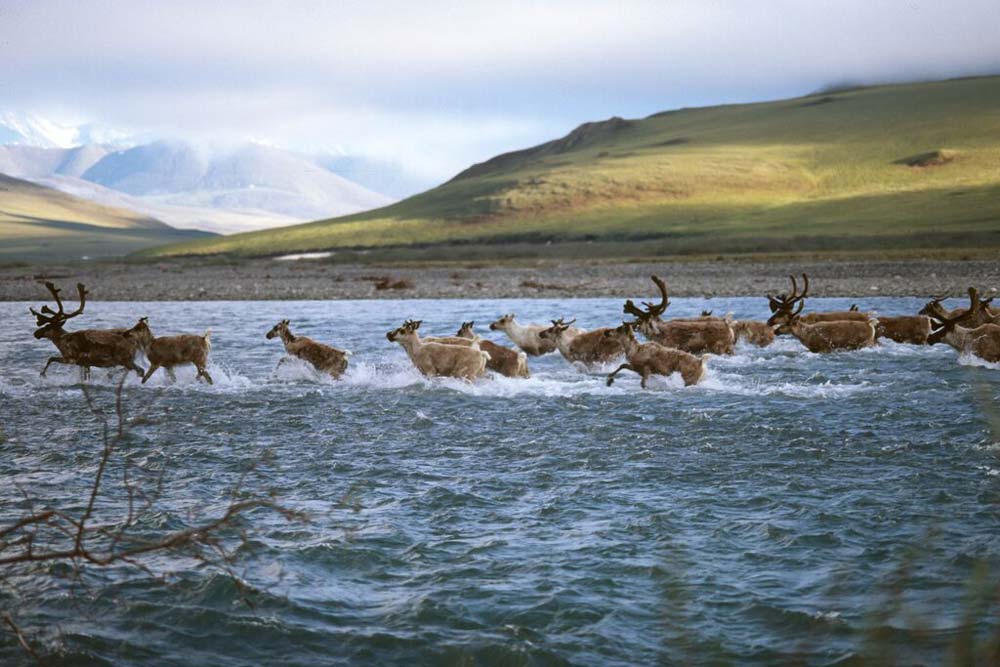
These habitats support a number of large animal species—including caribou, musk oxen, wolves,
Matthew J. Kotchen, Nicholas E. Burger, 2005
wolverines, and polar bears—and some 135 different bird species.

While the proposed area is much smaller than the total accessible landmass, BBC claims the land in question is a breeding ground for caribou, polar bears and many bird species. Disruptions due to oil spills, reproductive stress due to planes, helicopters and noisy extractors and tractors could obliterate local populations of animals and wildlife.
Meanwhile, temperatures are surging in the Arctic circle due to climate change, with one Siberian town hitting 38 degrees Celsius (100 F) this June.
Why should we be worried about warming in the Arctic?
Warming in the Arctic is leading to the thawing of once permanently frozen permafrost below ground. This is alarming scientists because as permafrost thaws, carbon dioxide and methane previously locked up below ground is released. These greenhouse gases can cause further warming, and further thawing of the permafrost, in a vicious cycle known as positive feedback.
https://www.bbc.com/news/science-environment-53140069
Endowments, states, and companies are increasingly looking at investor opinion to govern best business practices. Companies and investors are expected to take a stand on certain political issues such as climate change. In this new era of social responsibility, it will take a much higher profit margin for companies to drill in remote, fragile biospheres like the ANWR.
Among the opposition are also native Alaskan tribes, protecting their way of life. Subsistence farmers and hunters will be disproportionately affected by the loss in wildlife and climate effects wrought by big oil.
The November election continues to build in importance with issues like protection of domestic energy interests, climate change, conflict in the Middle East and the Baltics, biodiversity loss, and racial strife taking center stage. The economics of mining and drilling of the Arctic National Wildlife Refuge are not profitable with current oil prices and production/consumption levels, but someday they will be if we don’t look to the future of energy and consumption as our guide. By investing in green energy alternatives and steering policy away from oil subsidies, the government can achieve longer term goals of preserving wildlife and climate for future generations while still meeting tax and energy production quotas.
Vote in November. Thanks for reading,
-tommander
Link for data on the changing climate in AK: http://climate.gi.alaska.edu/history/History.html
 fungible thoughts
Leave a comment