

How do you define intelligence? A scene from Good Will Hunting comes to mind. “My boy’s wicked smaht.” What does wicked smaht leadership look like?
Here’s how the hard sciences are defining intelligence:
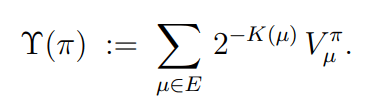
The equation above was developed by Shane Legg (Deepmind) and Marcus Hutter. It states that intelligence is directly related to achieving positive outcomes across all possible activities. The novelty lies in that the easiest activities have higher weights. So being good at a broad range of easy activities makes the machine more intelligent. The desired outcome is to create machines that are very good at a vast variety of simple tasks.
This is in contrast to F. Scott Fitzgerald‘s more humanitarian approach:
The test of a first-rate intelligence is the ability to hold two opposed ideas in the mind at the same time, and still retain the ability to function. One should, for example, be able to see that things are hopeless and yet be determined to make them otherwise.
The machine’s definition of intelligence is based on creation. If it does not accomplish some measurable activity, it is not intelligent. In the humanitarian definition, the emphasis is placed on being able to maintain one’s psyche.
Contrast
Legg and Hutter’s definition follows evolution’s vicious feedback loop of ever performing assets. Dead assets get left behind. It’s capitalism in an equation.
In the industrial revolution, managers and factory owners thought of laborers as little more than cogs in the wheel of production. If it’s not working, replace it. According to the equation, this is efficient and intelligent.
Workers would unionize and revolt for better working conditions, higher wages and workers’ rights. This is humanity’s hypothetical retort to the evolutionary process. We can’t function under such conditions. We need to breathe.
Bottom Line
The machine wants to know the most efficient way to get Mario from start to finish, but the humanities want to know if Mario even wants to go to the finish and if so, why?
Both have a place in business. To be likable is to be profitable. If you have a strong why, you have a better chance of being successful. If you are able to stay conscious that failure is an option, it creates stress, yes, but also urgency. It ensures you’re always looking over your shoulder.
If you’re intelligent in both ways, you’ll be much more successful and conscious of your success. You’ll have anxiety, but also a sense of accomplishment.
Intelligence in leadership is the ability to keep two conflicting ideas like success and failure at the front of your mind while still performing well on a vast variety of tasks. The more simple tasks you can accomplish with near perfection, the greater your intelligence will appear (according to the equation). But if you don’t know why you’re performing a task, you’re a machine. You’ll wake up one day to the fact that you’ve done everything for someone else, on someone else’s orders.
Humanities make us human. We can borrow all we want from evolutionary ideas as long as the reason for our pursuit of success remains at the very least acceptable, if not desirable. Humanities and capitalism will forever be locked in endless warfare.
We’re switching from a cog and wheel industrial society to a one-off consulting and creation society. The 40 hour work week makes less and less sense to my generation. I see this as a push back by the humanities against the capitalistic machine.
The humanitarian approach is that my quality of life is more important than my employer’s bottom line. The capitalistic approach is, “Fine. We’ll find someone else.”
Change the way you work.
Thanks for reading,
/tommander-in-chief
Sauces:
 fungible thoughts
Leave a comment