

Main themes as I saw them from the 2019 CFA Annual Conference in London:
- Growing Inequality
- Sustainable Investment and Climate Change
- Artificial Intelligence and Machine Learning
- Big Data
The first of these themes can be tied to the remaining three.
Inequality
There is a tangible dispersion between the haves and have-nots of the world, in terms of individual incomes and in terms of how capital has been invested globally. The share of total income earned by the top 10% in the US is approaching the levels the French elite earned prior to the 1790 revolution (See: Bastille Day).
| Total Income | % of Income Earned by Top 10% | |
| France Total Income 1790 in Today’s Dollars | $ 17.321 Trillion | 53% |
| US Total Income 2018 | $ 17.572 Trillion | 46%* |
*From 2016 (2018 unavailable)
Sources: France Income, US Income, FX Conversions
France’s affluence in 1790 is absurdly similar to the United States today, making the comparison all the more intimidating.
Distribution of Capital
Further, a disproportionate amount of capital is being deployed to firms that have a lions share of the world’s data.
Using the change in prices of publicly traded securities as a proxy for supply and demand, Apple, Google, Facebook, and Amazon are attracting massive amounts of the total supply of capital. The four companies alone accounted for 45% of the S&P 500’s price return last year alone. The top 18 names in the index* contributed 76% of the index’s price return.
- Tickers included: MSFT, AAPL, AMZN, FB, BRKB, JNJ, JPM, GOOG, OM, V, PG, BAC, DIS, VZ, CVX, CSCO, PFE
The S&P 500 is up 6.75% since last year (total return: price return + dividends). Meanwhile, the Russell 2000 is down over 3% over the last year. The Russell 2000 is a small-cap index. Clearly, the appetite for small company risk has waned since last year. The size factor (see Fama-French) has suffered as a result.
Who’s losing?
The banks. They contributed an 11% drag on the S&P 500 last year.
Banks have a ton of data but have failed to innovate, leaving room for fintech startups such as Revolut to take over. The youth of today see data as a method of exchange. They’re steering away from banks because there’s no exchange. We give them data about us and they fail to provide us with analytics about said data. Robo-advisors and other fintechs are growing because they provide a service the banks have failed to produce.
If big data is the driver, small companies clearly have a disadvantage. They don’t have access to the massive amounts of data in the age of artificial intelligence and machine learning. If these fields are the future, small companies will continue to underperform as the democratization of data continues to decline.
Data Tax
Provisions such as GDPR in Europe are signs that the public is realizing how much personal data is worth but is it enough?
There were several mentions of a “data tax”, where large companies like Facebook would be required by law to release certain types of data to the public. I look forward to seeing how lawmakers will deal with this.
Public vs. Private Markets
Whether it is a symptom of inequality or a driver is up for debate, but more and more companies are drawing capital from private markets rather than from public sources. Companies like Uber and Lyft are waiting longer and longer before going public to take advantage of cheap private capital. A few years ago, dry powder in private equity began to rise as deal flow began to fall, according to an April 2018 article from McKinsey. This was also exhibited in Howard Marks’ memo, The Seven Worst Words in the World from September last year. Spoiler, the words are “Too much money chasing too few deals”.
Here’s a stat for you from Bain & Co.:
…the average multiples investors have paid for public assets have almost always topped those paid for private assets, usually by as much as one to two times EBITDA…
As for periods when private multiples generally exceed the public average, there have been exactly three: during the “Barbarians at the Gate” era of the mid-1980s, during the exuberant run-up to the recent global financial crisis, and now.
That means the public has almost always had to pay more to get in on the action. Now the tables have turned. (See: Uber IPO)
Side note, The Barbarians at the Gate deal “…will wind up losing $730 million on the RJR Nabisco and Borden investments, according to one person who has been briefed on the details of Kohlberg Kravis finances.”
Even within private markets, we’re seeing a concentration trend over the last two years.
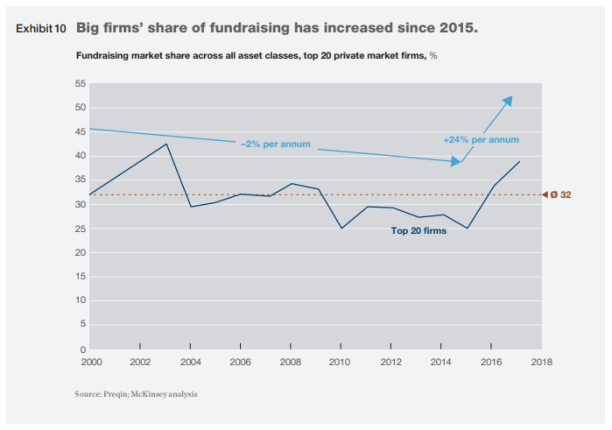
While not a comprehensive analysis, it offers another piece of evidence that private market funds are beginning to concentrate into fewer hands.
TL;DR
In conclusion, the haves are running away from the have-nots. Big data is king. The size factor is no longer being rewarded. The trend is your friend until it bends. Stay savvy friends.
Thanks for reading,
/tommander-in-chief
 fungible thoughts
Leave a comment