
Today’s market is frothy, no doubt about it. Everything’s near all time highs, even as central banks are set to cut rates again. There’s over 16 trillion dollars in negative yielding debt outstanding in global bond markets. Global growth and inflation have been tepid. Corporate debt issuance in the US is booming with cheap credit available at rates below 3%. Investment grade yields are hovering near record lows.
What a time to be alive.
Three groups have been identified as a danger to global financial integrity: yield chasers, pensions and funds required to purchase AAA rated bonds, and US below investment grade corporate issuers.
In 1981, corporate investment grade bonds were yielding over 16%. At the same time, defined benefit pension plans offered a seemingly conservative return of 7% or so guaranteed; payable upon retirement.* You could buy General Electric 10 year bonds @ 15% return per year or you could invest in a defined benefit pension plan at 7%; which would you choose in hindsight?
*Defined benefit pension schemes pay out benefits equal to what actuaries define as reasonable upon inception, which was 7% in some cases in the 1970’s and ’80’s.
Today investment grade corporate bonds yield roughly 2.87% on average. These pensions who promised 7% returns to investors (employees) are scrambling to find extra return. Some have mandates to only invest in investment grade debt; others have been able to change their mandates to allow for higher yielding, more risky debt purchases.
Therein lies the danger of record-low interest rates. Companies who are yield seekers, i.e. those who need to achieve a certain return in order to keep their balance sheets from toppling, are moving further out the risk curve. Those who used to invest only in AAA rated government debt in Europe and Asia are finding that those securities now yield negative interest. Thus, they have to move further out the risk curve in order to achieve positive returns.
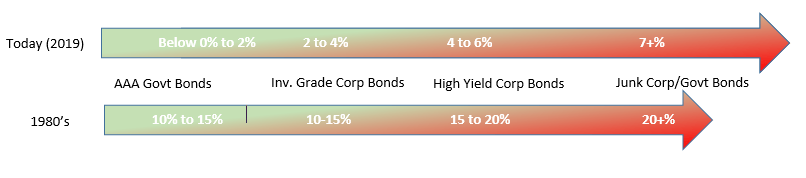
Just looking at the numbers, we can see there is significantly less meat on the bone. Granted, we had 13% inflation in 1980 in the US, compared to under 2% today, so you weren’t making massive real returns, but at least your pension could be funded.
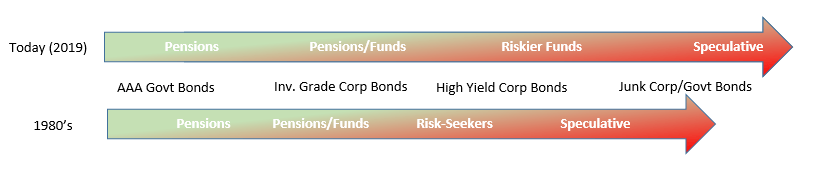
The above shows the mandates of each respective consumer group in financial markets. Speculative investors are forced to take on even more risk in order to get bang for their buck, as a result private equity and venture capital markets have exploded in popularity. In the above diagram, as you venture further into speculative territory there is more of a difference between Today and the 1980’s. Pensions are required to invest in a certain level of safety, thus do not deviate much from the types of investments they make, but speculative funds have needed to move further out the curve to provide the returns investors expect.
Pensions don’t have the mandate to move out the risk curve and thus run the risk of being underfunded. This is another big worry in financial markets. As record numbers of baby boomers move into retirement age, will pensions be able to stay afloat? Government social safety nets may be needed in the coming decades to keep pensions from going under at the expense of the people. Negative interest rates are dangerous.
Bottom line: more dollars are being invested in riskier securities. As rates continue to fall, economies will struggle to defeat this viscous cycle that is return seeking behavior. However, if it’s all part of the plan no one cares. If a highly speculative fund blows up, it’s their own fault. “They shouldn’t have been investing in such risky instruments,” you’ll think; when in reality, it’s systemic.
To measure how much shit we’re really in, we can measure interest expense ratios of high yield corporate issuers. This is how many times larger gross profit is than interest expense. Interest expense is the cost of servicing debt; if a company can’t service its debt, it goes into bankruptcy. From a January Reuters article:
While Federal Reserve officials acknowledge the possibility of a pause in monetary policy tightening this year, U.S. companies have already begun to have trouble servicing their debt. The ratio of a firm’s interest expenses to earnings before interest and tax – the so-called interest coverage ratio – has declined across non-bank firms since 2014.
Interest expenses have increased because of ballooning corporate debt loads in addition to Federal Reserve interest rate hikes. U.S. non-financial corporate business debt is 46 percent of gross domestic product, and is currently 4 percentage points higher than it was at the onset of the 2008 financial crisis, according to the IIF.
Scary stuff. Buy puts. 😉
Thanks for reading,
/tommander-in-chief
Meanwhile: climate change, UK Brexit troubles, Trump-Xi trade war, Hurricane Dorian, pumpkin spice lattes, NFL is back.
 fungible thoughts
Leave a comment