
I’d like to attempt to disavow a common misconception with trading in equity markets. Before you read, answer the following question:
What’s more important to trading: seeking gains or avoiding losses?
In popular media, the best traders are those that can pick the winners better than the rest. Hot take, the best traders are those who can avoid down days.
Take a look at the below chart.
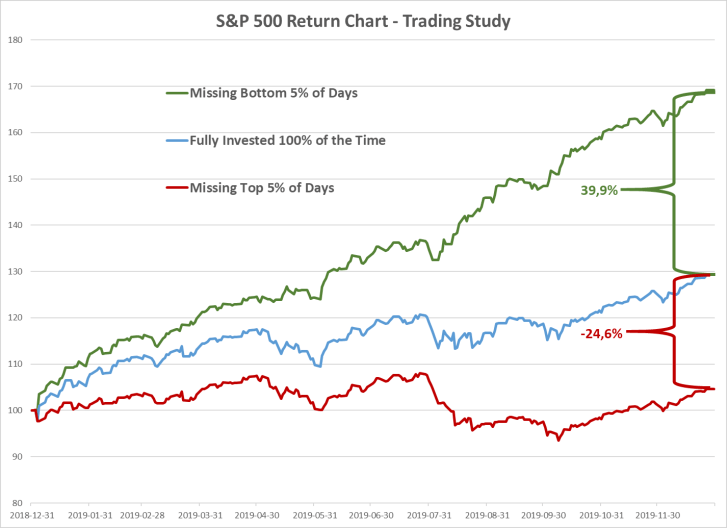
The dark green line shows your returns if you were to invest 100% of your money in the S&P 500 in all but the worst 5% of trading days last year. In other words, you invested in all but the 14 worst days of 2019. The dark red line is if were to have invested in all but the best 5% of days of 2019 (13 days). The blue line is your base case, where you were passively invested 100% of the time.
If you miss the worst 13 days of the market, you outperform the passive strategy by nearly 40%. If you missed the 13 best days in 2019, you under-perform by nearly 25%.
This isn’t a one off either. It holds across the Russell 2000 (which is an index consisting of 2000 small and mid-sized companies in the US), the Dow Jones, and the Swedish Index (OMXS30).
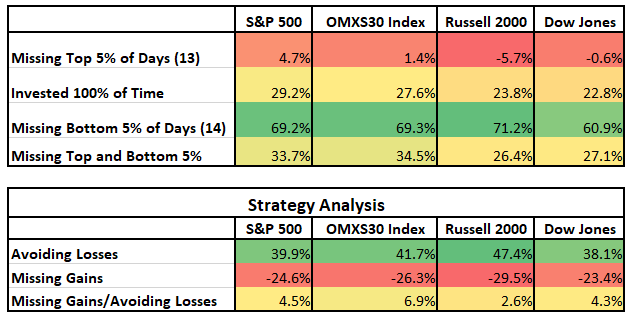
The final row in the top table above shows the returns of a trader who both missed the top 5% of days and avoided the bottom 5% of days.
The Strategy Analysis table shows the performance of each strategy relative to the just being invested 100% of the time. By avoiding losses we significantly outperform, but we also outperform the passive strategy even if we miss out of the top 5% of all trading days.
This is the case for active management. The best managers can avoid losses better than most, but occasionally they’ll miss out on the best days.
TL;DR As an individual investor (trader), your strategy should be to avoid losses while seeking to be invested on up days, not the other way around. Active management is not dead. Avoid losses first, then seek gains.
Thanks for reading and happy new year.
/Tommander-in-chief
Note: this data is only for 2019, further back-testing is needed before the results can be statically validated. The above is not a recommendation as I am not an accredited financial advisor. Opinions are my own and do not reflect on my employer.
Sauce:
- Data from Bloomberg
 fungible thoughts
Leave a comment