
This one goes off the rails a bit toward the end. If you get bogged down, I’d skip to the conclusion. Thanks for reading.
Those who are waiting, stashing their dry-powder (cash) in savings accounts, may have missed one of the greatest opportunities to purchase equities since 2009. Let’s have a look at how select industries have performed since March 2020, when markets tanked on news of a global shutdown.
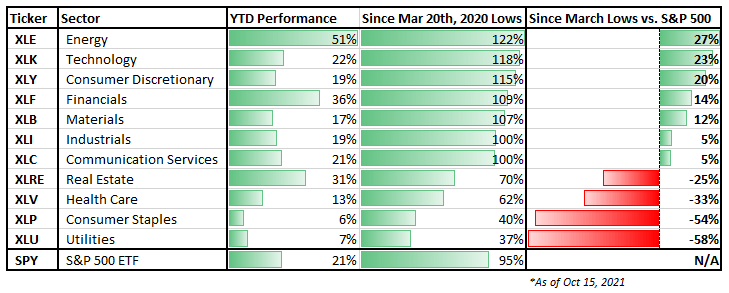
Utilities and Consumer Staples have been shellacked relative to the broader market, with Energy, Tech and Consumer Discretionary backpacking the market higher. Financials have also demonstrated strong performance both YTD and in the longer term. This makes sense as the narrative has been based on a “back to normal” attitude among talking heads.
Keep in mind that the S&P 500 is increasingly dependent on the largest mega-caps in the index. Eight names (AAPL, MSFT, AMN, GOOGL, FB, GOOG, TLSA, & NVDA), which are actually seven names due to Google having dual share listing, represent over 25% of the entire index.
Meme stocks (GME, AMC, BB, etc) have all been targeted by retail over the last two years. Anything with a large short interest has generated a lot of buzz, with many stocks seeing sharp rises despite less than stellar business models. High risk traders YOLO their capital on these names, hoping to make a large profit in a short amount of time exploiting something called a short squeeze.
In short (pun intended), shares can be lent several times over. If I own shares of GME and you think they’ll go down, you can borrow them from me for a fee, represented by an interest rate. If that fee goes up, you can lend them to the next chump at that higher rate and pocket the difference. This becomes a chain reaction on both sides. If the shares start to fall, the original lender may recall their shares, triggering massive buying as short sellers (borrowers of shares) scramble to buy back the shares that they’ve shorted to deliver them to the original lender. This triggers a short squeeze and the shares skyrocket.
After a share rises, sometimes, as in the case of GME and AMC, buyers who made money will rationalize their profits and HODL. They create investment theses around the growth prospects of the company, strengths and opportunities in the companies not so distant futures. This can become a bit of a feedback loop. If the share price can hold at higher levels, the company can find itself suddenly flush with new cash. They can move up the risk ladder, take on new debt, and execute on the strategies that spur growth. In the case of GME, for example, we know e-commerce is a giant problem for brick and mortar locations like Gamestop. Cash and debt used to invest in digitalization and hiring new C-suite staff can lead to the investment theses of armchair analysts actually coming to fruition.
Here’s a good screener for name with high short interest: https://www.highshortinterest.com/
Changing Gears
When I was in school, we were taught how to compare prices based on ratios, such a price to sales or price to earnings. Zero and negative interest rate policy combined with central bank stimulus has pushed valuation metrics, long held to be religious dogma in financial academic circles, to insane levels transforming these same metrics to little more than trivia overnight. For example, the Shiller PE was considered a common metric when studying price ranges for major indices.
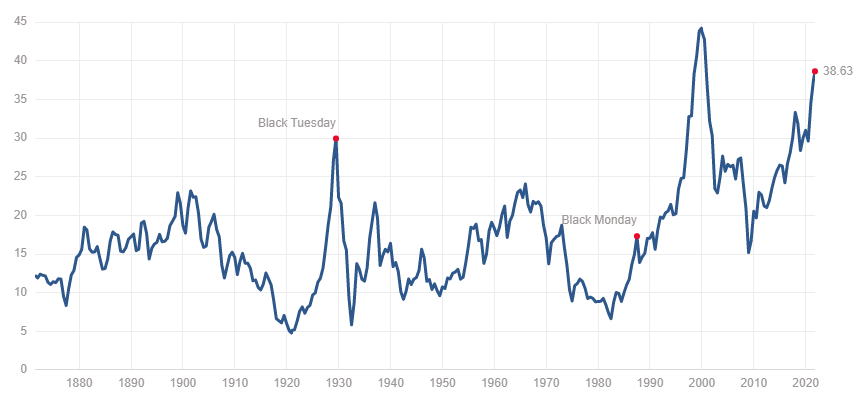
Throughout history, when this ratio rises to insane levels, we get a market correction. The ratio is feeding us a narrative of fear, though perhaps the financial equations by which markets operate have changed. (Famous last words…?)
Markets are smashing all time highs and interest rates are at record lows. We’re experiencing the perfect environment for investors, institutional as well as individual, to move up the risk ladder. The net return on a moonshot investment is now viable and even encouraged by the current environment. Technological investment is booming, with M&A activity on the rise from record levels. PWC estimates 2021 to “dramatically” outpace 2020.
Even as company valuations remain high and a seller’s market endures, demand for high-quality assets and the increasing willingness of some owners to sell them are accelerating deals that were thought to be two or three years away.
PWC
Conclusion
All this demonstrates that humanity is in an incredible position. We’re sending tourists to space, investing massive resources in decarbonizing the world and attempting to capitalize on the mega-boom of data creation. Facebook is rebranding, shooting for a meta-verse future. Video game sales and investment are at or near all time highs. News around groundbreaking discoveries in theoretical sciences are becoming so common, we barely glance at them before moving onto the next big thing!
For the vast majority of the human race’s brief lifetime, we’ve been entirely consumed with our most basic need: food. It’s only in the last 200 years or so that we’ve been able to become more specialized in our learning and productivity. As research and development activities continue to be funded through narrative feedback loops, we continue to expand our thirst for comfort and convenience.
If the world continues as it is, we’ll end up with a modern aristocracy. Wealth consolidation and income inequality are on the rise, all while jobs are becoming uber-specialized and training is becoming more expensive. The rich will send their offspring to the best training programs to become productive users, consumers, researchers, and producers of the most advanced technology in the known universe. The “poor” and semi-specialized will be wage workers, debt laden and comfortable in their electric vehicles; a mortgage and two and a half kids to look after. Big screen TV and a day job. Service industries will be the majority employer of the human race. Financial success and social mobility will not be based on how hard one works, but what one knows. We’ll have billions more people to employ and feed. The world will become safer through sheer economic dependence.
It’s an incredible time to be alive. The world that I’ve painted is not a foregone conclusion. If I stop to examine the morality of the human race, I believe the world our generation leaves behind will be better than we found it. We’ll still see disaster frequency and scale rise due to climate change. We’ll still have to bear the burden of each species we consume out of existence. Yet this loss of biosphere is not something to entirely avoid. In the name of progress, we may ascend to something resembling gods to our ancestors. We’ll manipulate genetic material. We’ll be able to eliminate the threat of an interstellar apocalypse. We’ll see into the intergalactic past to predict our future. Perhaps even discover other life.
It’s not something any one of us can control. It’ll just happen to the vast majority of us. Is that something to be lamented?
Thoughts for your Wednesday.
Thanks for reading, /tommander
Disclaimer: Do your own research before investing. I’m not a licensed investment advisor. The opinions presented are my own and do not reflect on my employer.
 fungible thoughts
Leave a comment